
Is your kitchen small but you still want it to perform at its best?
Then you’ve come to the right place. A small kitchen doesn’t have to be an impossible puzzle; on the contrary, when the layout fits, everything flows. Literally.
Here are 7 real-life layouts that work in small kitchens, highlighting their strengths, what to watch out for, and when it’s worth choosing them. Because at Hausvetica, we firmly believe that there are no small kitchens, just poorly utilized spaces.
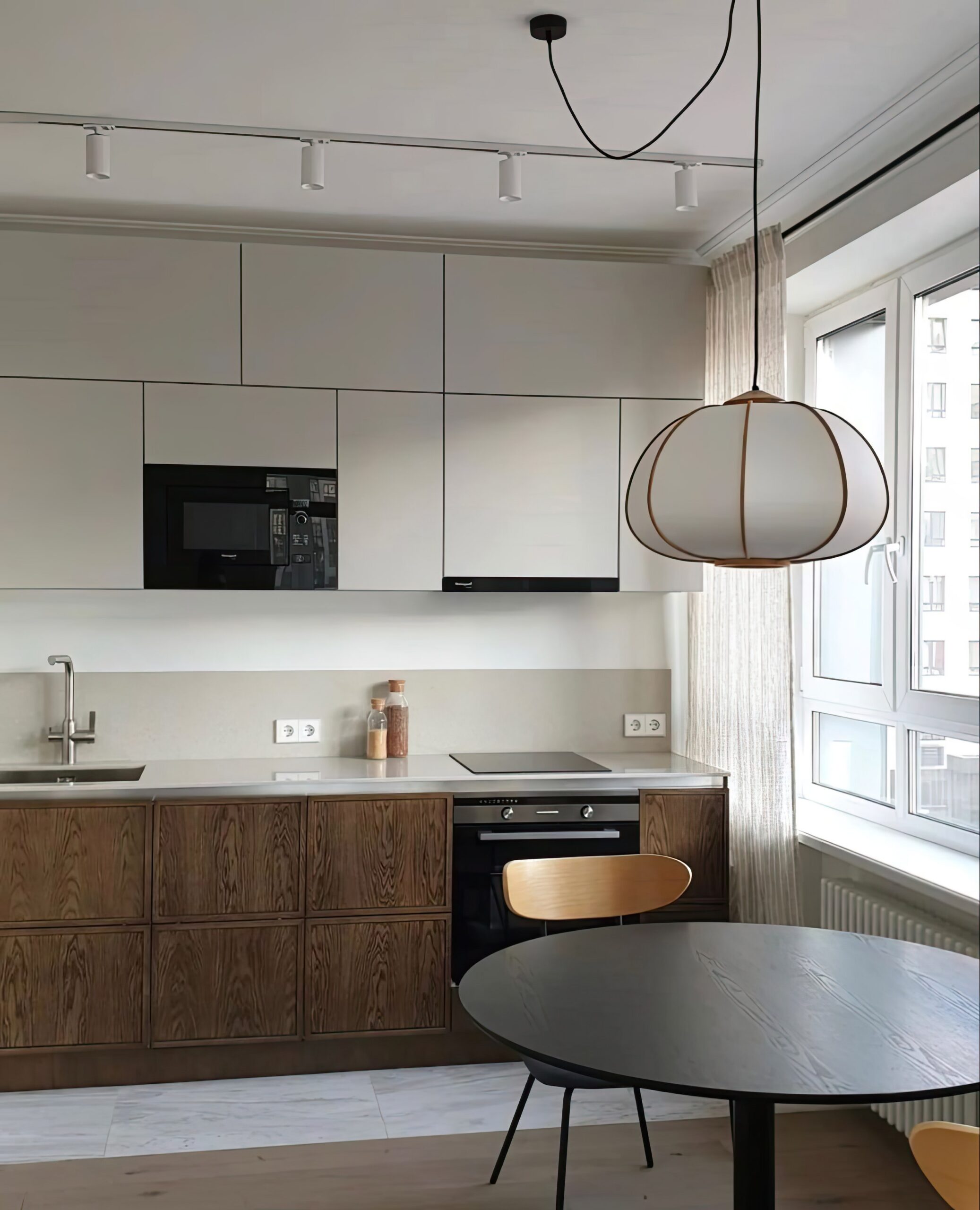
1. Single-line Kitchen: Simple (and Effective)
The classic. All furniture and appliances are arranged on a single wall. Minimalist, practical, and ideal for elongated or narrow spaces.
When to choose it:
- When the width of your kitchen is no more than 2 meters.
- In studios or apartments where the kitchen opens into the living room.
Advantages:
- Easy to design and execute.
- Fits perfectly in open spaces.
- Leaves the opposite wall free (great for tall cabinets or decorative elements).
Watch out:
The work triangle becomes inefficient if the sink, stove, and fridge are too far apart.
What is the work triangle?
It’s a basic kitchen design rule that connects the three key areas: cooking (stove), washing (sink), and storage (fridge). The idea is to form an imaginary triangle that makes movement easy and avoids unnecessary steps. When placed correctly, cooking is comfortable and smooth. When poorly distributed, you’ll feel the strain from the first dish.
2. L-shaped Kitchen: Well-Used Corner
Perfect if your kitchen is in a corner. It uses two adjacent walls to form a practical angle with more countertop space.
When to choose it:
- For square or slightly rectangular kitchens.
- If you want to add a small table or even a bar on the open side.
Advantages:
- Allows space for a small dining area or peninsula.
- Promotes good circulation.
- The work triangle is much easier to design efficiently.
3. U-shaped Kitchen: Maximum Space Utilization
Three sides, three work surfaces, three storage zones. An encompassing layout, perfect for those who love to cook seriously.
When to choose it:
- For square or closed kitchens at least 2.40 meters wide.
- If you need large storage and extra workspace.
Advantages:
- Highly efficient work triangle.
- Clear separation between cooking, washing, and preparation.
- Works well for two people cooking at once.
Watch out:
Avoid overcrowding all three walls with upper cabinets, or the space will feel cramped.
4. Kitchen with an Island (Yes, Even in Small Spaces)
Who said an island only fits in XXL kitchens? With reduced dimensions (1 to 1.20 meters), it can serve as support, a bar, or additional storage.
When to choose it:
- Open kitchens with at least 2.80 meters in width.
- If you want to visually divide the space without building walls.
Advantages:
- Combines style and functionality.
- Can serve as an impromptu dining area.
- Adds additional storage space.
Tip: If you don’t have the required width, opt for a peninsula. More compact, with the same visual effect.
5. Parallel Kitchen: The Solution for Hallways
Two opposite walls with a central passage. Ideal for long and wide kitchens.
When to choose it:
- When the width is at least 2.20 meters.
- If you need to fit in multiple appliances.
Advantages:
- Very efficient when the work triangle is well thought out.
- Naturally divides the cooking and washing zones.
- Offers a good balance between aesthetics and functionality.
Tip: Keep at least 90 cm in the central passage to move around comfortably.
6. Integrated Bar Kitchen: Compact but Social
The natural evolution of the open kitchen. Instead of an island, a bar connects the kitchen and the living room. Perfect for a quick breakfast or chatting while preparing a meal.
When to choose it:
- Small apartments or lofts.
- If you prefer to skip a traditional dining table.
Advantages:
- Adds a sense of spaciousness to the room.
- Can be used for eating, working, or simply resting items.
- Provides extra workspace.
Important: Leave at least 90 cm behind the bar for comfortable movement.
7. Hidden Kitchen or “Surprise Box”: For the Minimalists
Increasingly popular: compact kitchens that disappear behind sliding doors or panels. Total visual cleanliness.
When to choose it:
- In studios or apartments where the kitchen is always visible.
- If you value visual order as much as design.
Advantages:
- Works in truly small kitchens.
- Simply close the panel, and the clutter is gone.
- Modern and discreet aesthetic.
Note: It requires a bigger investment and a good initial design.
Conclusion: Your Small Kitchen Can Be Big in Functionality
Having limited space doesn’t mean you have to sacrifice design or comfort. On the contrary: small kitchens that work are the ones that are well thought out. With a smart layout and a little ingenuity, your kitchen can become the heart of your home, even if it’s tiny.
Are you already picturing yours? At Hausvetica, we know how to bring your dream kitchen to life. Let’s talk!